Showing posts with label House Rules. Show all posts

Monday, 23 May 2022

House Rule: How to Get Rid of Clerics (& Druids & Paladins)

Here's how I'm getting rid of Clerics and Druids and Paladins in my OSE based game:

The classes are unavailable for both PCs and Players. Their spells - with the exception of Cure Light Wounds, Cure Serious Wounds, Commune, and Raise Dead - are available to Magic-Users. 

Randomly generated Magic-User spells on level-up are still generated from the Magic-User Spell list, so the spells have to be obtained through play.

Where a Druid or Cleric spell also appears on the Magic-User list but at a different level, use the spell level from the Magic-User list.

That's it.

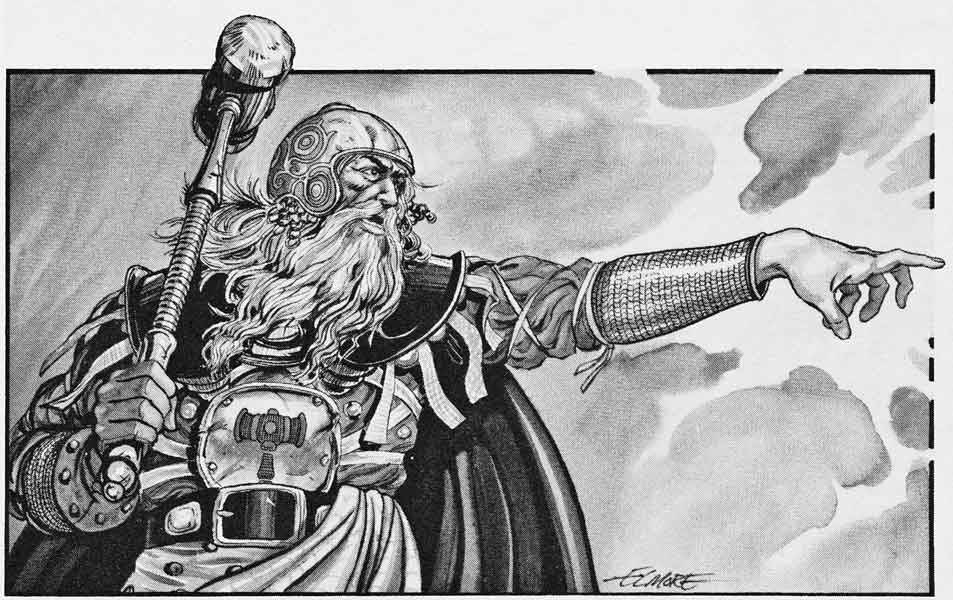
The Cleric class illustration from the Mentzer Basic Set
(Larry Elmore)

You may ask "why?" Or you may not, but I will answer nonetheless.

The reason why I don't want divine casters in my game is threefold: I don't like easily available healing magic; I like to keep the spiritual/ divine element of the game less knowable and game optimizable; and in I find the whole blunt weapons + armour + siloed spells thing for Clerics pretty naff (this is obviously a subjective thing).

In general, I tend to prefer somewhere between this writeup on polytheism from A Collection of Unmitigated Pedantry and Black Streams: Cult of Ruin for my religion in my Old School Fantasy Gaming.

As for how it'll impact the game, I've added a Bonus Hit Point mechanic which I think will more or less balance out the lack of Cure Wounds spells.

On the DM side - where a pre-published module features a Cleric I will either convert them to a Magic-User, to some sort of Cultist, or a Fighter with religious inclinations (which ultimately is just another flavour of Cultist) as appropriate.

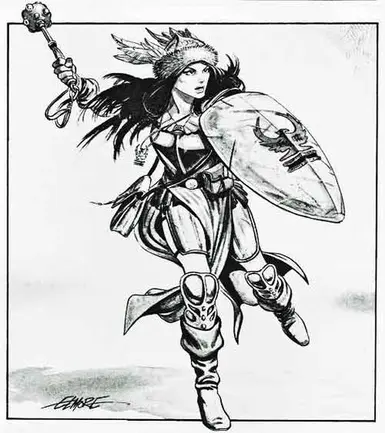
The Cleric class illustration from the Mentzer Expert set.
(Larry Elmore)

Tuesday, 17 May 2022

House Rule: Keep Going & How Bad Is It

Here are my house rules for adding a bit of tension and survivability to reaching 0 hp, as well as increase the opportunities for heroic/ desperate self-sacrifice.

If a natural 20 attack roll takes you to 0 HP, you are dead. If a single source of damage does more damage than your Constitution score and takes you to 0 HP, you are dead.

If you are at 0 HP but not dead, you can try to Keep Going. Otherwise you are Down. 

If you are Down you can't do anything. Once combat is over, you roll on the How Bad Is It table.

If you try to Keep Going, you make a Save vs Death. If you succeed you can act normally until next round. If you fail, you are Down.

If you Keep Going, every new round and every time you take damage, you must make a new Save vs Death or go Down. You get a -1 to the Saving Throw for each save you have already made. This negative modifier also applies to your roll on the How Bad Is It table.

This means it gets harder and harder to Keep Going, and the longer you do it the more likely it is that you will die. It's up to you how hard you want to push your luck. You can always chose to go Down rather than try to Keep Going.

How Bad Is It

RollHow Bad Is It
3 or lessDead
4Mangled
5-6Wounded
7-8Hurt
9+Just a Scratch

Dead
You are dead.

Mangled
If you are left to your own devices, roll a d6. On 1-3 you are dead (or otherwise disappear from player control). On 4-6 you show up in a safe place in d6 seasons, with only d6 of your current items still in your possession. Lose two randomly determined stat points and gain one randomly determined point as a result of the ordeal.

If someone brings you to safety and puts you in care you are useless for d4 seasons, at which point you are back to normal. Lose two randomly determined stat point and gain one as a result of the ordeal.

Wounded
You suffer -2 to attack, damage, and saving throws and your move is reduced by 30' (10') until you spend a full week resting and recuperating. Recover 1 HP.

Hurt
You suffer the same penalties as if you're wounded, but a good nights rest and a square meal will remove the penalties. Recover d4 + Con modifier hit points (can't be more than your max HP, can't be less than 1).

Just a Scratch
Maybe you were knocked out, maybe you had the wind knocked out of you. Whatever it is, you pick yourself up and can continue. Recover d6 + Con modifier hit points (can't be more than your max HP, can't be less than 1).

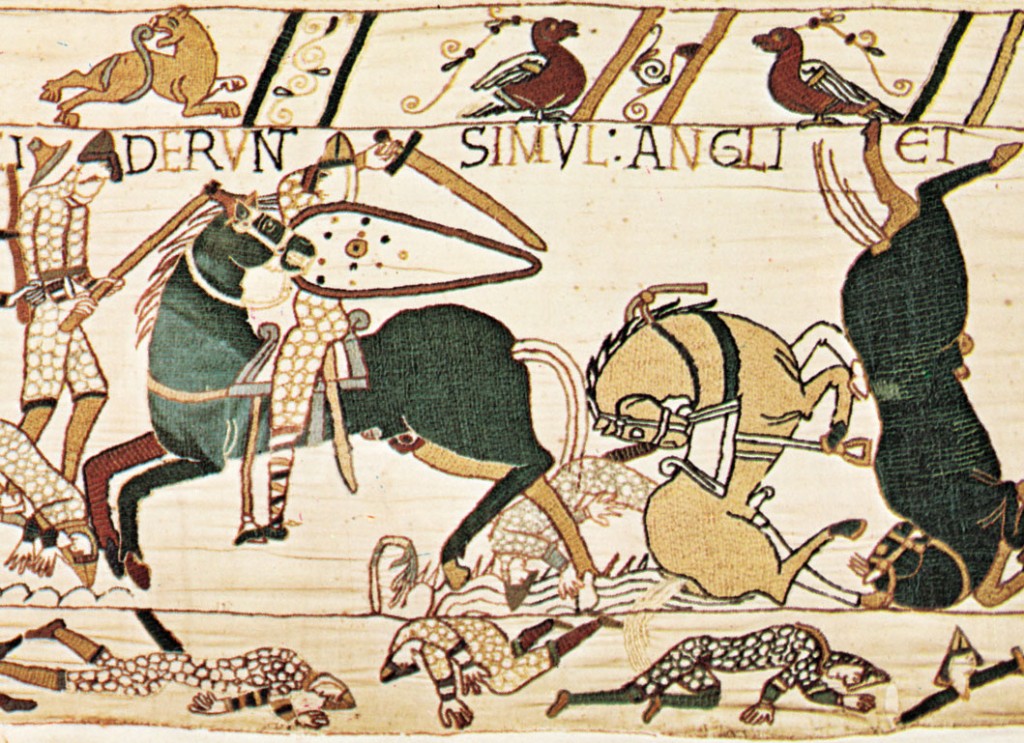
Some of these folks are most likely hurt or worse.
(Bayeux Tapestry)

Some Thoughts

I wasn't sure whether to add the automatic death rules (and I had several different ideas), but in the end I went with some. It makes Shields even more of a big deal (due to Shields Shall Be Splintered), but maybe you want to save them for the critical moment.

How Bad Is It can be used without Keep Going if you'd like.

There are a probably a bunch of edge cases where it makes sense that 0 HP just = dead (you're in a vacuum, you drown, etc). I'm not going to write all that out, just rule on it when it comes up.

It does add a bit of extra survivability, it's true. However, in the game this is intended for Clerical healing is not really available (and no Raise Dead), so I expect that it'll be fine. I do have to test it out in actual play though. I do kind of encourage players to have a back-up character ready at all times - whether it's an additional level 1 rolled up or some sort of henchperson or hireling.

Also, I'm totally applying these rules to NPCs and Monsters as well (where it feels appropriate), even though the rules are phrased to be player facing.

Last but not least, the long recovery times fit in with other house rules I'm planning on using, with the intended effect to give a longer more natural sense of the passage of time. We'll see if it works. If that doesn't suit you, feel free to change those time periods (or let Clerical magic fix everything).

Sunday, 8 May 2022

House Rule: The Good Life (& Bonus HP)

One of the things that make the Hobbit and LotR feel real to me is how important food and accommodation is. Camping in the rain kind of sucks. Catching and eating a rabbit - even at the risk of giving away your location - is an important morale boost. I want a bit of that vibe in my game, and hey I already have a table for determining whether the weather is poor.

Also, as you may recall if you've been reading along, I've done away with Clerics and attendant common healing spells. This puts PCs a bit behind the baseline curve in terms of survival.

One of the ways I'm going to address it is to involve more healing springs and weird shrines where you roll a d6 (or whatever) and maybe you get healed. But that's for later.

This post is about Bonus Hit Points, and how I intend (hope) for them to help things a bit. This is also a way to add a bit of structure to the passage of days, and add some of that "maybe let's not camp in the rain and eat iron rations" flavour if possible.

A convivial time at the Prancing Pony is sure to raise your spirits
(Jian Guo aka breath-art)

Bonus HP

First off, my the general implementation of Bonus HP. 

  1. Bonus HP from different sources do not stack. That means if you have 3 Bonus HP and you get d6 Bonus HP from a night's rest, you will have 4, 5, or 6 Bonus HP if you roll that number on the die, and you will have 3 Bonus HP if you roll a 1, 2, or 3.
  2. Bonus HP are depleted before regular HP, but cannot be used to heal lost HP.
Many things give bonus HP - primarily comestibles and generally living the good life, but also spiritual blessings and whatnot.

Before the Adventure

If you spend some time before the adventure doing something more normal than scouring the countryside for treasures while fighting who-knows-what, you start with Bonus HP. How much depends on your standard of living and for how long you've been taking it easy.

QuartersDayWeekSeason
Rough*1d4d6
Commond4d6d8
Fined6d8d10
Opulentd8d10d12
*Requires gear to counter any weather effects

Rough = Sleeping out of doors and eating thin fare. If it's raining, you better have a tent, and if it's cold you better have some blankets and a fire.

Common = How most people live. As long as you have a decent roof over you head, square meals, and a comfortable place to sleep, this applies.

Fine = You're living the good life, with people attending to your needs, high quality food and drink. Equivalent to the standard of living of successful city merchants, average nobility, and the like.

Opulent = you live like a King, Empress, or someone otherwise in the top 1%.

And yes, this does mean that your standard level 1 PCs just starting out their careers get either d6 or d8 bonus HP in the beginning (because they've probably spent more than a season doing non-adventuring things). It might take the sting out of rolling a one on their hit dice.

Other Sources

Like I said have a some ideas for other sources of Bonus HP. They include things like: boons from religious practices, fancy elf-wine, tasty local specialties of certain villages, and so on. That's something I'll detail later, though.

Tuesday, 12 April 2022

House Rule: Shields Shall Be Splintered! but are also a bit better

Part of the purpose of this blog is for me to make decisions on the house rules for my upcoming game and put them somewhere, so some of these posts are going to be restating (and probably tweaking) other people's excellent work. This is one such post.

Years ago Trollsmyth proposed a houserule called "Shields Shall Be Splintered". Here's my take on shields, drawing on that.

Shields provide +2 AC

Shields shall be splintered: when taking damage from a melee attack, a shield wielder can elect to have their shield be destroyed and not take the damage. This option is also available for magical shields, with the addition that magical shields can even ward against more esoteric things like lightning bolts, dragon breath, death rays, thrown boulders, and things like that. But the shield still breaks, so you better make sure it's worth it.

The shield stopped an arrow, which is pretty good.
(Morris Meredith Williams)
So yeah, +2 to AC is more than usual, but I think that'll make the decision to sacrifice the shield a bit more interesting. It may result in the party having retainers along carrying spare shields (shield-bearers as it were), but that's fine.

I probably will put some ways to pro-actively destroy shields in as well - maybe as some sort of weapon property of axes. But that's a future worry.

Saturday, 9 April 2022

House Rule: Weather Table (for Simulacrum Overland)

The Simulacrum Overland system (discussed in this post) imposes a number of modifiers on travelling depending on the weather, so I've built myself a little d6 table for that.

RollSpringSummerFallWinterWinter Temp
1Poor *Nice*Poor*Poor*Extreme
2PoorNicePoorPoorAs yesterday
3PoorNiceAs yesterdayPoorAs yesterday
4NiceNiceNiceAs yesterdayAs yesterday
5NiceNiceNiceNiceFine
6NiceNiceNiceNiceFine
*Roll d6 again. If it comes up 1, there's a Major Storm

Poor Weather = +1 to exploration cost

Nice Weather = no change in cost

Extreme Temperature = +1 to exploration cost. Only rolled for in the winter.

Major Storm = additional +1 to exploration cost (this is not part of Simulacrum Overland, but I wanted the dramatic effect of a massive storm occasionally making everything all dramatic and inconvenient).

In addition, I've decided that unless roads are Roman quality or well maintained, they only reduce travel/ exploration cost by -1 in summer. The rest of the year they're deep tracks of mud - they'll help you find your route, but will be very slow going.

Wouldn't want to try to cross that stream in a heavy downpour
(Simeon Larson)

Notes

The table implies a temperate kind of climate. It doesn't get extremely warm even in summer but winters can get significantly cold (sometimes enough to impact travel) in the winter. I think I might make more weather tables for various regions to further differentiate regions, but this will do as a starting point.

Summer is obviously the best time to campaign and explore, while the other seasons are more dicey, which hits my preference for pseudo-historical RealLife(tm) flavour. Spring, on the other hand is both muddy and with unpredictable weather.

You'll also note that the table is not concerned with specifics of temperature or what exactly is going on to impede travel or what degree of rain counts as "Poor" vs "Nice". That's something I'll determine at the table, just like I'll interpret reaction roll results based on context.

Finally, I think I'll probably roll the weather a day or two in advance to give a bit of foreshadowing and possible allow appropriate PCs and NPCs a chance at predicting the weather where appropriate.

Monday, 4 April 2022

House Rule: Variable Study Time

House Rule: When memorizing spells roll d6. That's the total level of spells the caster can memorize. If memorizing spells after a full day of rest (or rather a full day dedicated to studying) roll 2d6 for the total level of spells.

For example, if the caster rolled a 3 after a night's sleep they can choose to memorize three first level spells, one spell each of the first and second levels, or one third level spell.

Obviously a spellbook
(Jeff Easley)

My thinking is that this will counter the "adventuring day" concept a bit, potentially provide some meaningful choices under time pressure for higher level casters without impacting low level casters. This will obviously add days to get casters back to full readiness. This is intentional and will (hopefully) line up with other house rules and tweaks.

The Variable Study Time house rule is intended for OSE, but is applicable to most Vancian casting rule sets I imagine.

That's it. Simple and elegant, I think. More potentially hard choices to make while adventuring. Not tested in actual play yet, though.

...

I crunched the numbers a bit (see the table below), using the OSE Magic-User spell progression. Assuming average rolls (3.5 for active days, 7 for full days dedicated to studying).

Level 1 and 2 Magic-Users can expect to get all their spells back after a single study session on average. If they dedicate a full day to studying they can expect on average to get all their spells back as long as they're L4 or less; with the best roll even a L6 MU can fill all their spell slots.

At the high end of the scale, a L14 MU will on average need something like 21 days to fill all their spell slots if they're gallivanting about. If they buckle down and study all day long, it should take on average 11 days.

It also means to memorize high level spells, the MU is better off spending the day studying (the chances of getting a 6 is much less on 1d6 than on 2d6). This fits the fiction of powerful but anti-social spellcasters IMO.

Class LevelActiveFull DaySpell Levels123456
10.30.1411
20.60.2922
31.10.57421
41.70.86622
52.61.299221
63.41.7112222
74.92.43173221
86.63.29233322
98.94.433133321
1011.45.714033332
1113.46.7147433321
1217.18.5760443332
1319.79.8669444333
1420.910.4373444433

This matches what I'm looking for in my game, but obviously it can be adjusted by changing the dice rolled, adding modifiers etc.